
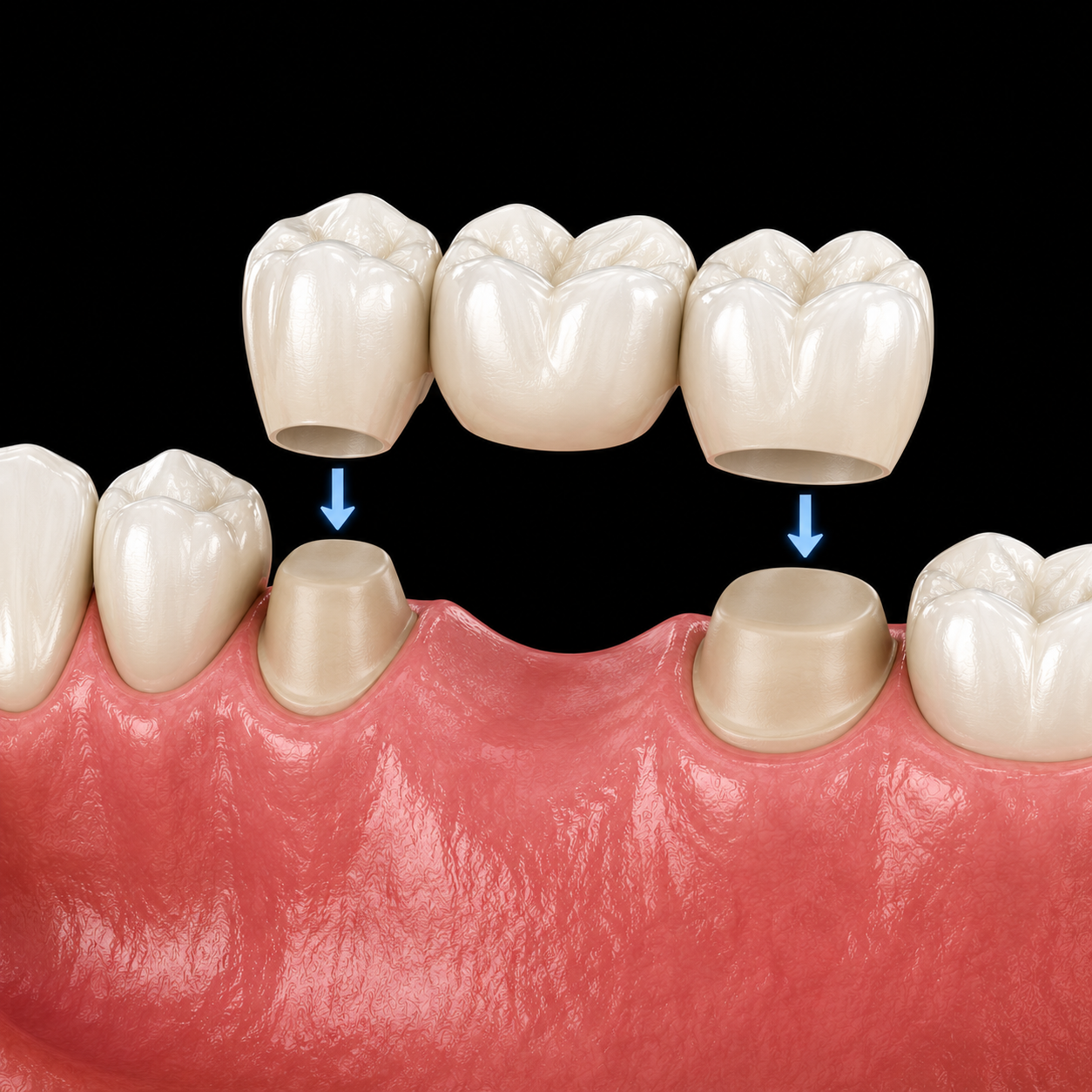
Types of Bridges We Offer
- Traditional Bridge – a false tooth held in place by crowns fitted on the adjacent natural teeth
- Cantilever Bridge – anchored to a natural tooth on only one side, used when there’s only one neighbouring tooth
- Maryland Bridge – held in place with a metal or porcelain framework bonded to the back of neighbouring teeth, with minimal reshaping needed
- Implant-Supported Bridge – anchored to dental implants rather than natural teeth, ideal for replacing several missing teeth in a row
What Happens During Treatment
- Consultation & examination – assessing the gap and the health of neighbouring teeth
- Preparing the anchor teeth – the supporting teeth are gently reshaped to hold the bridge (not needed for implant-supported bridges)
- Impressions – a precise mold taken to custom-fit your bridge
- Temporary bridge – placed while your permanent one is being made
- Final fitting – your custom bridge is checked for fit and bite, then permanently cemented in place
Why Choose a Dental Bridge
- Restores chewing and speech – fills gaps that affect how you bite and speak
- Prevents shifting teeth – stops neighbouring teeth from drifting into the empty space
- Maintains facial shape – supports the natural structure of your jaw and cheeks
- Natural appearance – shade-matched to blend with your existing teeth
Who This Is For
- Anyone missing one or a few teeth in a row
- Patients who prefer a fixed (non-removable) solution over a partial denture
- Patients not suited for or interested in dental implants
Book Your Bridge Consultation
Ready to close the gap? Call, WhatsApp, or book online for an assessment with Dr. Rakay Ahmed.ed or heavily filled tooth, a crown may be the right solution. Call, WhatsApp, or book online for an assessment.or you.